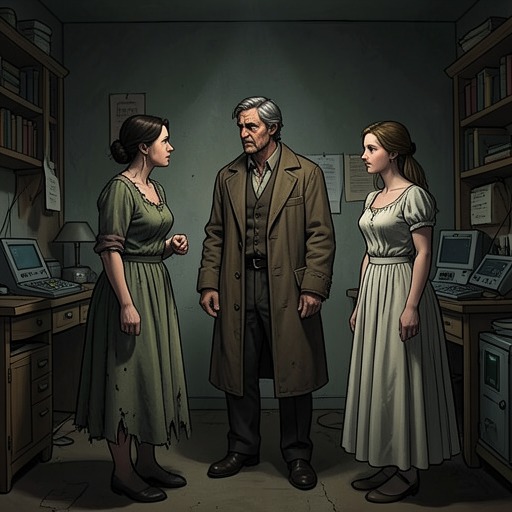
Amanda Wingfield–Tom Wingfield mother–son relationship
The Glass MenagerieThe mother–son relationship between Amanda Wingfield and Tom Wingfield is the play’s central negotiation between family obligation and escape. Amanda treats Tom as both her indispensable provider and the person responsible for securing Laura’s future; Tom cares for his family but experiences the work and duties that bind him to them as a threat to the life he wants. Their exchanges move between tenderness and accusation, making dependence not an abstract condition but the daily substance of their attachment.
Identity and Background
Amanda is a mother living with her adult children in a precarious household whose prospects depend heavily on Tom’s employment. She sees herself as having fought alone for years, and calls Tom her “right-hand bower,” a partner on whom she relies not only for income but for the family’s continuity. Tom is the son who works at a warehouse and gives up, in his account, his dreams and ambitions for a monthly wage. Their unequal positions within the household are inseparable from their closeness: Amanda needs him to stay, while Tom needs a way to imagine a life beyond staying.
The relationship unfolds against the social and economic pressures Tom identifies in his opening address. He situates the play in the 1930s, when a “dissolving economy” unsettles the middle class, and recalls labor disturbances in cities including Chicago and St. Louis. This backdrop does not by itself explain the Wingfields’ specific circumstances, but it frames the insecurity that gives Amanda’s demand for dependable work its force and makes Tom’s low-paid job feel like both a support and a trap.
Care, Dependence, and Laura’s Future
Amanda’s anxiety about Laura turns Tom’s role as son into a demand for continuing responsibility. She says Laura is two years older than Tom, has no settled direction, and frightens her by seeming simply to drift. Laura’s business-college failure and unsuccessful attempt to join the Young People’s League deepen Amanda’s fear that her daughter cannot establish an independent life. Amanda therefore does not treat Tom’s possible departure as a private choice: she connects it to the question of who will look after Laura.
Her picture of the future is stark. Amanda imagines unmarried women without a position living on relatives’ grudging support, moved between small rooms and dependent on in-laws. She sees marriage as one possible alternative to such dependence, but her immediate concern is practical: Laura needs a home and someone to care for her. Tom’s own description of Laura as a “home girl” does not satisfy Amanda, who insists that a home is meaningful only if it belongs to Laura and includes a husband. Their disagreement shows how Amanda’s protection of her daughter is also shaped by the limited futures she can envision for women without work or marriage.
Amanda makes Tom’s freedom conditional on Laura’s security. Having discovered a letter from the Merchant Marine, she recognizes that he dreams of leaving and compares him to his father, who went out without explanation and then abandoned the family. She tells Tom that he may go wherever he pleases, by land or sea, once Laura is married, has her own home, and is independent. Until then, she says, he must look out for his sister. The bargain expresses genuine concern for Laura, but it also places the burden of resolving her future on Tom and makes his own future contingent on an outcome he cannot control alone.
Work, Anger, and Reconciliation
Tom’s resistance is clearest when Amanda challenges him over his job and the household’s security. He insists that he is not in love with the warehouse or the Continental Shoemakers, and contrasts his dreams with the repetitive work he expects to return to each morning. He says he earns sixty-five dollars a month while surrendering what he dreams of doing and becoming. When Amanda accuses him of thinking only of himself, he answers that he would have left already if that were true, pointing to his father’s photograph as the image of the person who is gone. The exchange exposes the contradiction at the heart of their bond: Tom resents being held in place, yet understands his continued presence as evidence that he has not simply abandoned his family.
Amanda’s concern is not confined to his future plans. She reminds him of the light bill she gave him after the household received notices about it, a small but concrete sign of how much domestic security depends on his attention and wages. In another dispute, after Tom says he cannot face matters, Amanda asks what right he has to jeopardize his job and the security of them all. Her fear converts his frustration into a threat to the whole household, while his anger makes clear how unbearable he finds being treated as the household’s guarantee.
The quarrels do not erase their capacity for tenderness. After one outburst, Tom awkwardly rises from the table and apologizes to Amanda, saying he is sorry for what he said and did not mean it. Amanda breaks into tears. She explains that worry and sleeplessness have made her nervous, then returns to the image of having fought alone and calls Tom her right-hand bower. Tom answers gently that he tries. Her pride in both her children and her plea that he not fail him show that she can recognize his value with warmth even as she asks him to carry an immense responsibility.
Household Expectations and Conflict
Amanda also tries to shape Tom’s conduct through the family’s preparations for Laura’s first gentleman caller. She insists that the home cannot receive a caller in disorder: the wedding silver must be polished, the monogrammed linen washed, the windows cleaned, fresh curtains put up, and appropriate clothes found. Tom objects that the young man is no one to make a fuss over, but Amanda emphasizes that Laura has never before received a caller. Her preparations reveal how much hope she invests in a social visit, and how quickly that hope becomes a family obligation Tom is expected to support.
The conflict reaches a sharper point after the visit disappoints Amanda’s hopes. She lists the new floor lamp, rug, and clothes purchased for Laura, then accuses Tom of having made the family look foolish by bringing home another girl’s fiancé. She invokes her own abandonment and Laura’s disability and unemployment as reasons Tom should not leave them to pursue his pleasure. Tom answers that the more she calls him selfish, the sooner he will go; when Amanda tells him to go, he insists that he will, and she calls him a selfish dreamer. The exchange turns the preparations for Laura into another measure of Tom’s obligations and makes the cost of their mutual dependence audible in their language.
Amanda’s efforts to manage Laura’s presentation offer a related, smaller instance of her controlling care. She puts powder puffs into Laura’s clothing and names them “Gay Deceivers”; Laura refuses to wear them, and Amanda insists. The episode is directed at Laura, not Tom, but it belongs to the household atmosphere in which Amanda tries to secure her children’s prospects by arranging appearances and behavior. Tom’s disputes with his mother occur within that same effort to make the family’s uncertain future manageable.
Meaning of the Relationship
The relationship is neither simple devotion nor mere hostility. Amanda’s demands arise from fear of poverty, dependence, and the prospect that Laura will be left without support; her attachment to Tom appears in her pride, her confession of worry, and her expectation that he will not fail. Tom, meanwhile, does not deny that he is supporting the family, but he resists the idea that this sacrifice should determine the rest of his life. His apologies show that the conflict wounds him, while his anger shows that affection alone cannot make the arrangement tolerable.
Their recurring struggle gives the family’s economic vulnerability an intimate form. The warehouse wage, the overdue light bill, Laura’s failed attempts at a career, and Amanda’s hope for a suitable caller all press on the same question: who can afford to leave, and who must remain responsible for those who cannot? Amanda answers by tying Tom’s departure to Laura’s independence; Tom experiences that condition as another postponement of his own. The relationship’s defining tension is that care binds them together while the very form that care takes becomes a source of confinement.